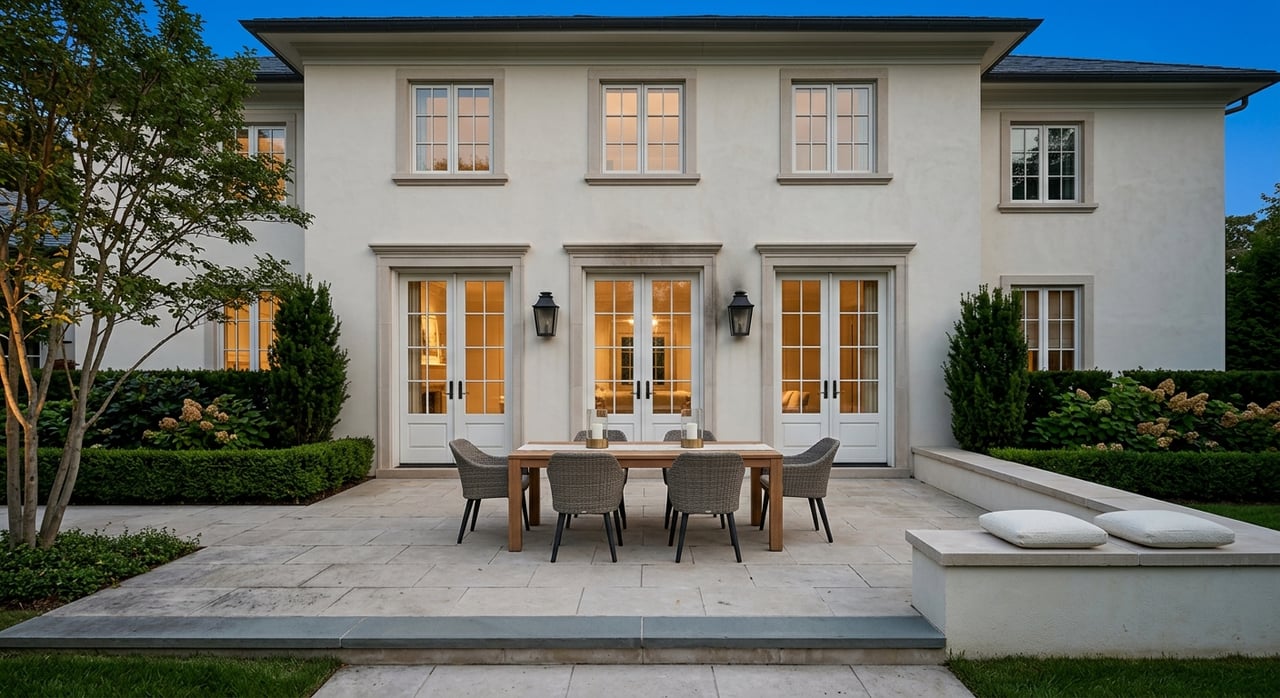
Wondering what “estate living” in Muttontown really means before you buy? It is a smart question, because this North Shore village offers a distinctive mix of history, land, privacy, and regulation that can vary more from property to property than many buyers expect. If you are looking for space, a strong sense of place, and a true estate setting, understanding those differences can help you buy with more confidence. Let’s take a closer look.
Muttontown’s estate identity runs deep
Muttontown is not just a village with a few large homes scattered throughout. The village describes itself as a North Shore community of more than 4,500 acres, shaped from former estates and known for its Gold Coast character, preserves, and substantial properties.
That background matters when you are evaluating real estate here. Muttontown’s history helps explain why many homesites feel more expansive and private than in a typical suburban setting, and why the landscape still carries a legacy-estate feel.
Former New York City estates became places that still define the village today, including the Muttontown Golf and Country Club and Woodcrest Acres. The former Brewster Estate became part of what is now the preserve, including Hoffman Center and Chelsea Mansion.
Nature and history shape the setting
One of the clearest examples of Muttontown’s character is the Muttontown Preserve. County and conservation sources describe it as roughly 550 to 568 acres, making it Nassau County’s largest nature preserve.
For buyers, that translates into more than scenic value. The preserve includes woodlands, fields, ponds, trails, estate grounds, and historic structures, all of which contribute to the sense that this is a place where open space and estate history still influence daily life.
If you are drawn to a setting that feels established rather than newly created, this is part of the appeal. In Muttontown, the landscape is often as important as the house itself.
Lot sizes vary more than buyers expect
A common mistake is assuming every home in Muttontown sits on the same kind of oversized parcel. In reality, the village includes several residential zoning districts with different minimum lot sizes.
Here is a simple snapshot of what the village code allows:
| District | Minimum Lot Size |
|---|---|
| A-3 | 0.5 acre |
| A-2 | 1 acre |
| A-1 | 2 acres |
| E-3 | 3 acres |
| E-5 | 5 acres |
This means Muttontown offers a range of property types, even though its reputation leans heavily toward larger estate holdings. If you want a classic estate feel, checking the zoning district is one of the first and most important steps.
Why the E-3 district matters
For many estate-focused buyers, the E-3 district is especially relevant. The village code allows some flexibility in subdivision design in E-3 areas, but even then, the net computable lot area for an approved lot cannot be less than two acres.
That is a strong sign that Muttontown actively protects a low-density pattern. Even where flexibility exists, the village is still oriented toward preserving space and an estate-style setting.
A recent official filing shows how this can play out. In the Silver Path Estates subdivision, a former 98.92-acre estate in the E-3 district was proposed as 20 single-family lots ranging from 3.00 to 5.38 acres, along with buffers, wetlands protection, and a bridle trail connection to the nearby preserve.
Estate living is not one single lifestyle
“Estate living” in Muttontown can mean different things depending on the property. Some homes offer privacy through acreage, setbacks, and mature landscape screening. Others are part of a more structured residential setting with shared amenities and governance.
That distinction matters if you are trying to match a home to your lifestyle. Two properties may both be in Muttontown, yet offer very different day-to-day experiences.
Private acreage versus gated community living
Stone Hill at Muttontown is a clear example of the planned-community side of estate living. The community describes itself as a gated, European-influenced development with 80 estate home-sites on 148 acres, with a double-gated entrance staffed 24 hours a day.
Residents there also have access to a private clubhouse, tennis, an indoor pool, and exercise equipment. For some buyers, that kind of managed environment is appealing because it combines scale and privacy with amenities and a more defined community structure.
By contrast, a legacy parcel elsewhere in the village may deliver privacy through land, distance, and mature grounds rather than through gates or shared amenities. Neither approach is inherently better. It simply depends on how you want to live.
What large properties may allow
One reason Muttontown appeals to buyers seeking a more rural estate environment is that the village code allows certain accessory uses in A-1, E-3, and E-5 districts. Subject to detailed conditions and setbacks, those uses can include the noncommercial keeping of dogs, poultry, birds, bees, horses, and livestock.
That does not mean every property is set up for equestrian use or similar features. It does mean that larger-site living here can include elements that would be uncommon in a more conventional suburban setting.
If features like horse facilities, expansive outdoor amenities, or specialty accessory improvements matter to you, zoning review should be part of your search from the beginning. It is much easier to rule in the right opportunities early than to discover limitations after you are under contract.
Approvals can be more involved here
Muttontown places a strong emphasis on preserving village character. Its Site and Architectural Review Board reviews new construction with attention to the rural nature of the village, open space, natural surroundings, topography, exterior design, materials, siting, and the broader countryside setting.
For buyers, that can affect timelines and expectations. If you are planning exterior changes, additions, or a new build, the review process may be more detailed than what you would encounter in a typical suburban municipality.
This is not necessarily a negative. Many buyers see it as part of what helps protect the area’s visual character and long-term appeal. Still, it is important to go in with clear eyes about the approval path.
Privacy rules are specific
Buyers are often drawn to Muttontown for privacy, but privacy here is shaped by rules as much as by acreage. The village generally requires a building permit for fences and fence-like walls, and fence height is typically capped at 6.5 feet unless the Zoning Board of Appeals approves otherwise.
The code also restricts the visibility of trailers, campers, motor homes, mobile homes, and boats from the street and neighboring properties. These details may seem minor at first, but they can affect how you use and screen a property.
If your vision includes gates, walls, or extensive perimeter work, it is worth confirming the rules before you move forward. In estate settings, privacy design often needs to work within a structured regulatory framework.
Guesthouse expectations need careful review
This is one of the most important diligence points for estate buyers. The village generally prohibits new accessory dwellings and allows only limited treatment for accessory dwellings that legally existed before November 1, 1973.
If you are hoping for a guesthouse, staff space, or separate multigenerational living arrangement, you should verify exactly what is legal on the parcel you are considering. This is not an area where assumptions are safe.
In a market where large homes may suggest flexible living options, this rule can surprise buyers. A property’s size and appearance do not automatically mean the layout or accessory structures are permitted in the way you expect.
Parcel-by-parcel diligence matters
Muttontown is not a place where broad assumptions serve buyers well. The village’s helpful information identifies four public school districts that serve properties within the village: Jericho, Syosset, Oyster Bay-East Norwich, and Locust Valley.
That means school assignment should be confirmed for the specific parcel rather than assumed based on a mailing address or nearby listing. The same goes for utilities, fire department coverage, and other service details.
What to verify before you buy
If you are considering an estate purchase in Muttontown, it helps to review a property through a practical lens. Key items include:
- The zoning district and minimum lot size
- Whether any accessory dwelling is legally permitted
- Fence and gate requirements
- HOA rules, if the property is in a planned community
- Wetland, drainage, or steep-slope constraints
- The exact public school district assignment
- Utility and service-provider details
These checks are especially important on wooded parcels, properties near preserved land, or homes in areas where subdivision and environmental protections affect future use.
Why buyers are still drawn here
Even with added diligence, Muttontown remains compelling for buyers who want privacy, land, and a strong North Shore estate atmosphere. The appeal is not just square footage. It is the combination of space, history, preserved landscape, and a sense of permanence.
For the right buyer, that tradeoff is well worth it. You may have more homework to do here than in a more conventional suburb, but in return, you gain access to a setting that feels distinctive and hard to replicate.
A thoughtful purchase in Muttontown starts with understanding that each property tells its own story. If you want guidance that balances design awareness, local knowledge, and practical due diligence, Karen Sharf can help you navigate the details with clarity and care.
FAQs
What does estate living in Muttontown usually mean?
- In Muttontown, estate living usually refers to larger lots, lower-density surroundings, significant privacy, and a landscape shaped by former Gold Coast estates and preserved open space.
Are all homes in Muttontown on multi-acre lots?
- No. Village zoning includes minimum lot sizes ranging from a half-acre in A-3 districts up to five acres in E-5 districts, so lot size depends on the specific property and district.
What should buyers check before purchasing a Muttontown estate?
- Buyers should verify zoning, minimum lot size, accessory dwelling rules, fence and gate regulations, HOA requirements if applicable, environmental constraints, utility details, and the exact school district assignment for the parcel.
Can you add a guesthouse on a Muttontown property?
- Buyers should not assume that is allowed, because the village generally prohibits new accessory dwellings and only provides limited treatment for certain pre-existing legal accessory dwellings.
Are there gated communities in Muttontown?
- Yes. Stone Hill at Muttontown is one example of a gated community with 80 estate home-sites, staffed entry, and private resident amenities.
Why do Muttontown properties feel so different from one another?
- Properties can differ significantly because zoning districts, lot sizes, HOA structure, environmental features, and approval requirements vary across the village.