The hanging baskets are back on the lampposts. The Dawn Redwood at Bailey has finished its spring flush and settled into that soft, feathered green. On Birch Hill Road the reservation books are filling by Wednesday for weekend tables, and on Dogwood Lane a small parking area sits quiet until Saturday morning, when it fills with people who have driven fifteen minutes for a stepping-stone path they could not find on their first try. This is Locust Valley in July, working at its own tempo.
The season's quiet alignment
Something is different about the summer of 2026 in this one-square-mile hamlet, and it has nothing to do with what is being built. It has to do with two calendars finally lining up.
Bailey Arboretum, the 42-acre former estate of horticulturist Frank Bailey on Bayville Road, is open Wednesday through Sunday, 9 AM to 5 PM, with no admission or parking fees for the 2026 season and donations accepted at the information kiosk. That is a meaningful shift for a neighborhood park that had previously suggested a modest adult fee.
The John P. Humes Japanese Stroll Garden, tucked at the end of Dogwood Lane, runs the opposite schedule: Saturday 10 AM to 2 PM and Sunday 1 PM to 5 PM, and it is only in season roughly May through October. This year the North Shore Land Alliance has stacked the summer weekends with programming, including Shakuhachi performances, the traditional Japanese end-blown bamboo flute, on select Saturdays and a tea ceremony demonstration led by Omotesenke Domonkai Eastern Region on October 10th at 3:30 PM to close the season.
The practical result for residents: two very different outdoor rooms, on complementary calendars, both within a short drive of the village center. A midweek stroll through 42 acres of specimen trees. A weekend twenty minutes of contemplative silence on a stone path. The hamlet has always had these. It has rarely had them working in this kind of concert.
Locust Valley rewards the slow weekend. The village is small enough that a single Saturday can hold a garden, a lunch, a bookstore stop, and a car show, and you will still be home before the light goes.
Two gardens, two moods
If you already live here, you know these places. What may be new this year is the case for treating them as a pair rather than a choice.
| Bailey Arboretum | Humes Japanese Stroll Garden | |
|---|---|---|
| Feel | 42 acres, wooded trails, ponds, specimen trees | 7 acres, stepping-stone path, tea house, koi pond |
| Season | Wednesday through Sunday, year-round hours vary | Weekends only, May through October |
| 2026 admission | No fees this season | Donation-based, run by North Shore Land Alliance |
| Signature | Frank Bailey's Dawn Redwood, rose and lily beds | Ashikaga-period tea house, moss collection, bamboo |
| Best for | A long, unstructured walk with kids or a dog | Twenty minutes of stillness, ideally alone |
The Humes garden is the one that catches out first-time visitors. In 2017 the North Shore Land Alliance purchased the garden from the Humes family, completing a conservation corridor of over 150 contiguous acres in the Beaver Brook watershed that links the Stroll Garden and Humes property to Shu Swamp Preserve, Upper Francis Pond Preserve, and the two Francis Ponds. That corridor is the real story: the garden is not a standalone attraction but the front door to a much larger protected woodland the village has been quietly assembling for decades.
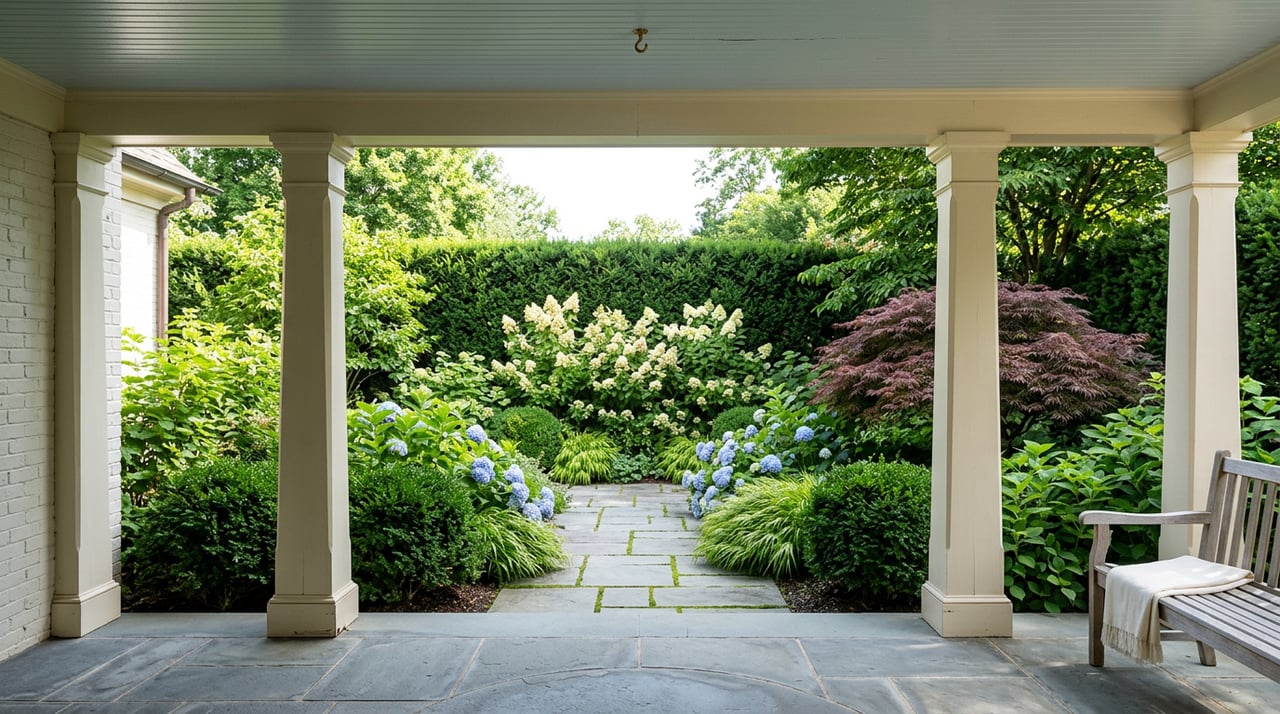
Views, textures, and compositional elements in the garden have been balanced according to Japanese aesthetic principles, immersing visitors in an idealized landscape inspired by a mountain setting by the sea. The defining feature is a stepping stone path inspired by the intimacy of a mountain path, taking visitors through various twists and turns, including a "mountain peak," before ending at the pondside Tea House. Twenty minutes, at most, to walk the entire loop. Long enough to reset a week.
Where the village is eating
The dining district in Locust Valley is compact by design. Birch Hill Road and The Plaza between them hold most of what residents actually go to, and this summer the lineup rewards knowing the difference between them.
For a weekend dinner with visitors from the city
- Two25, at 225 Birch Hill Road. Modern Italian, run by owners from Italy, handmade pastas and Neapolitan pizza. Currently open Tuesday through Sunday, closed Mondays, with kitchen hours running until 9:00 PM most nights and 9:30 PM Friday and Saturday. Worth knowing: the owners have a second restaurant opening soon in Glen Head, so the group's footprint is quietly expanding on the North Shore.
- Birch Hill Bistro. A 32-seat French bistro inspired by a classic Parisian café, focused on seasonal ingredients and timeless technique, with a wine list of French and local selections. The dining room includes window booths and tables that peek into the open kitchen, and the restaurant does not advertise private dining for large parties. A room this size books up quickly; reserve mid-week for a weekend table.
For a long, familiar evening
- The Brass Rail, a gastropub in the village that has settled into a reliable neighborhood standby.
- Basil Leaf Café & Ristorante, at 7B The Plaza. For over 30 years, owned by Vito Patronelli, nestled in a shopping center in Locust Valley, with multiple dining rooms that suit both a quiet dinner and larger gatherings.
- Barney's, an American restaurant styled as a country inn. Good for a milestone dinner or a work celebration where the room needs to hold twenty.
For everyday and off-hours
- Buckram Stables Cafe, casual and named for the village's older name.
- Stuey's Smokehouse BBQ, mostly takeout with a few stools.
For after dinner
- The Valley Piano Bar @ The Plaza. The ambiance has a European flair with floral leaf wallpaper and ebony wood panels, tables with armchairs, banquettes, soft lighting, and brightly colored cushions, creating a refined atmosphere for a special evening. Piano and vocals Thursday through Saturday from 6 to 9 PM, a live DJ those same nights from 9 PM until late, and a Greek Night the last Friday of every month. This is the closest thing the village has to a late room.
The compact geography matters here. You can finish a bottle at Basil Leaf, walk a hundred feet to hear piano at the Valley, and be home in ten minutes.
The community calendar, in order
Summer in Locust Valley is not one big event. It is a steady drip of small ones, most produced by the Chamber of Commerce or its neighborhood partners.
The through-line is the Chamber's stated mission of preserving the charm and authenticity of the hamlet through beautification and social events, including the annual hanging baskets that give the town its summer color. If you have wondered why the flower baskets appear each June without any municipal announcement, that is the answer. They are privately organized and privately funded.
Beyond the baskets, three summer traditions are worth putting on a calendar:
- Cars, Coffee & Charity. A June car show on Birch Hill Road benefiting Grenville Baker Boys & Girls Club, with cars, food, raffles, and shopping, sponsored by local businesses across the village. It is the closest thing Locust Valley has to a street festival, and it is unapologetically about the club.
- The autumn family event. Not summer, but summer's payoff. An annual autumn family event with kids' activities, games, face painting, henna tattoos, shopping, raffles, food trucks, and live music. Late September into early October is when the Chamber begins publicizing dates.
- The holiday shopping and tree lighting run. Holiday cheer and bubbly for shopping through town, with the Chamber reminding residents to make dinner reservations so they can drop in after they shop, culminating in the annual tree lighting produced by the Locust Valley Chamber of Commerce and the Matinecock Neighborhood Association.
The village's institutional memory runs deep. A peaceful setting of elegant homes, rolling hills, two-lane roads and woods, Locust Valley was settled in 1667 as part of the larger Matinecock region. English farmers in 1730 renamed the local area Buckram after Buckenham in Norfolk County, England, and at a public meeting in 1856 the name became Locust Valley in view of the many locust trees in the area. The Buckram Stables Cafe is not a marketing conceit. It is a direct thread to what this place was called for 126 years.
A walk worth planning
If you have out-of-town guests this July or August and you want to show them what living here actually feels like, resist the urge to drive them past the estates. Park once, on foot in the village, and do this:
Coffee at Buckram Stables. Twenty minutes at the independent shops in the quaint outdoor arrangement near 31 The Plaza, including the small antique-and-decor shop with enameled pieces, mirrored trays, and beautiful decorative pieces for the home and the person. A lunch at Birch Hill Bistro or Basil Leaf. Then get in the car for the fifteen minutes to Bailey or the twelve to Humes, whichever fits the day and the mood.
The point is not to move fast. Locust Valley is a one-square-mile, quaint, unincorporated hamlet, a hidden gem to most Long Islanders, with a wide identity that also serves the surrounding incorporated villages of Lattingtown, Matinecock, and Mill Neck. The pleasure of a summer weekend here is that you can see most of it in a day and still feel as though you have not rushed anything.
That is not an accident of geography. It is the result of a village that has consciously chosen, decade after decade, to stay this scale.
If a home in this part of the North Shore is on your mind, or you have simply lived here long enough to be curious what your property might do in a market that continues to reward well-cared-for houses on quiet streets, Karen Sharf would welcome the conversation. Let's Connect.